The Electric Muse Revisited by Robert Shelton
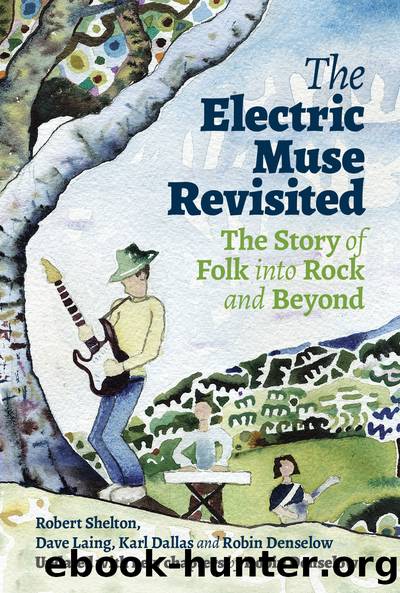
Author:Robert Shelton
Language: eng
Format: epub
Publisher: Omnibus Press
Published: 2021-06-15T00:00:00+00:00
SOURCES
Youâll find the originals of many of the electric folk âchartbustersâ on albums in the Topic, Leader and Trailer catalogues, sung by country singers, collected mainly in the fifties and onwards, or by various revivalists. The best kaleidoscope of the traditional origins of electric balladry will be found in Topicâs ten-volume Folk Songs of Britain. For instance, Volume 8, A Soldierâs Life for Me, includes the originals of Steeleyeâs âWhen I Was On Horsebackâ, âThe Banks Of The Nileâ and âPrince Charlie Stewartâ. Two failings of this anthology should, however, be borne in mind: the fact that it treats the six or seven separate traditions of this Disunited Kingdom as one (the mythical âBritainâ of the collectionâs title) and the fact that some of the songs are denuded of some of their verses. Though they are printed in full in an accompanying booklet, this truncation encourages the singer to think of all the verses as being sung to the same tune as the first, whereas it is of the essence of folk music that each verse varies, melodically, in keeping with the pace of the narration. Each time the song is performed, of course, a new set of variations occurs.
Other strong traditional influences have been Harry Cox, who appears on several volumes of Folk Songs of Britain and has two albums to himself, English Folk Singer (EFDSS LP1004) and Traditional English Love Songs (Folk Legacy FSB20), which has the original of Steeleyeâs âSpotted Cowâ on it, as well as the rhythmically fascinating âBetsy The Serving Maidâ referred to in the text; Phil Tanner (EFDSS LP1005), from whose recording came âThe Gower Wassailâ for Steeleye; and the Coppers (EFDSS LP1002, Leader LEA 4046/9), from whom stem the glee-type harmonies used by some groups for their ensemble singing. The Coppersâ repertoire has more effect in the folk clubs than on the electric scene, though.
Some of Fairportâs traditional repertoire is hard to trace: the words of their âMatty Grovesâ were dictated to them over the phone when they were working on Liege and Lief, but the tune is basically similar to that of the American Hedy West, recorded on âPretty Saroâ (Topic 12T146).
The list of songs electric folk has acquired via the redoubtable Bert Lloyd, sometimes passed on more or less as he got them, sometimes extensively reworked, is really remarkable. We would be much poorer without his talent for spotting a good song, for instance âBlackwatersideâ, âA Sailorâs Lifeâ, âReynardineâ, âThe Deserterâ, âJack Orionâ (the latter more or less an original song on the theme of the traditional âGlasgerionâ), and âThe Handloom Weaver And The Factory Maidâ. A fine singer, though very idiosyncratic and less traditional in style than is sometimes believed, he has not always been well served by his recordings, but First Person (Topic 12T118) almost does him justice.
Lloyd and Ewan MacColl (aka Jimmy Miller) did an interesting set of recordings of ballads from the collection of Professor F.J. Child for Riverside many years ago which was criticised by musicologists at the time for the rather mannered singing and wayward way with texts and tunes.
Download
This site does not store any files on its server. We only index and link to content provided by other sites. Please contact the content providers to delete copyright contents if any and email us, we'll remove relevant links or contents immediately.
The Goal (Off-Campus #4) by Elle Kennedy(13625)
Kathy Andrews Collection by Kathy Andrews(11777)
Diary of a Player by Brad Paisley(7531)
What Does This Button Do? by Bruce Dickinson(6176)
Assassin’s Fate by Robin Hobb(6173)
Big Little Lies by Liane Moriarty(5759)
Altered Sensations by David Pantalony(5080)
Pale Blue Dot by Carl Sagan(4968)
Sticky Fingers by Joe Hagan(4156)
The Death of the Heart by Elizabeth Bowen(3589)
The Heroin Diaries by Nikki Sixx(3525)
Beneath These Shadows by Meghan March(3285)
Confessions of a Video Vixen by Karrine Steffans(3283)
How Music Works by David Byrne(3239)
The Help by Kathryn Stockett(3127)
Jam by Jam (epub)(3060)
Harry Potter 4 - Harry Potter and The Goblet of Fire by J.K.Rowling(3038)
Computational Linguistics and Intelligent Text Processing: 20th International Conference, CICLing 2019 La Rochelle, France, April 7â13, 2019 Revised Selected Papers, Part I by Alexander Gelbukh(2968)
Strange Fascination: David Bowie: The Definitive Story by David Buckley(2844)
